Does Self-Help Actually Increase Anxiety? The Evidence
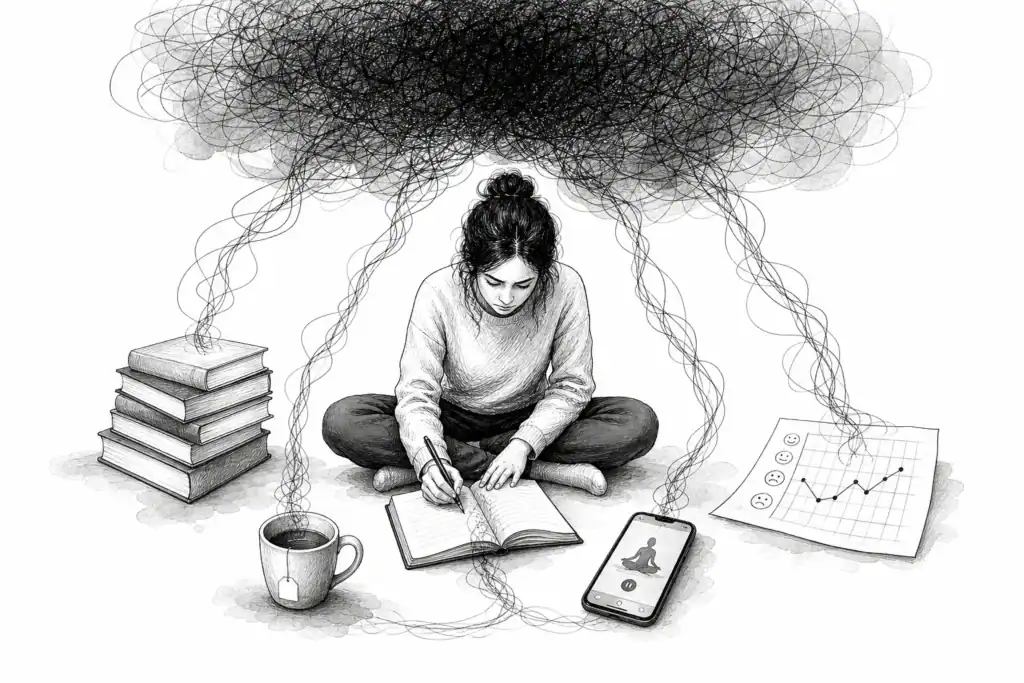
Most people arrive here carrying a quiet suspicion they have not said out loud: that all the journals, apps, breathing exercises and books have somehow made the anxiety worse, not better. They tried harder. The anxiety is still there, sometimes heavier than before they started. That suspicion deserves a straight answer, not reassurance.
The research on self-help is messier than the wellness industry admits. A landmark meta-analysis of self-help interventions found that, pooled across studies, the effect on anxiety was small, a standardized mean difference of just -0.10, and it failed to reach statistical significance. The picture changes once you separate guided from unguided approaches. What gets sold as one category, “self-help,” is really two different things, and treating them as one has led a lot of people to the wrong conclusion about what works.
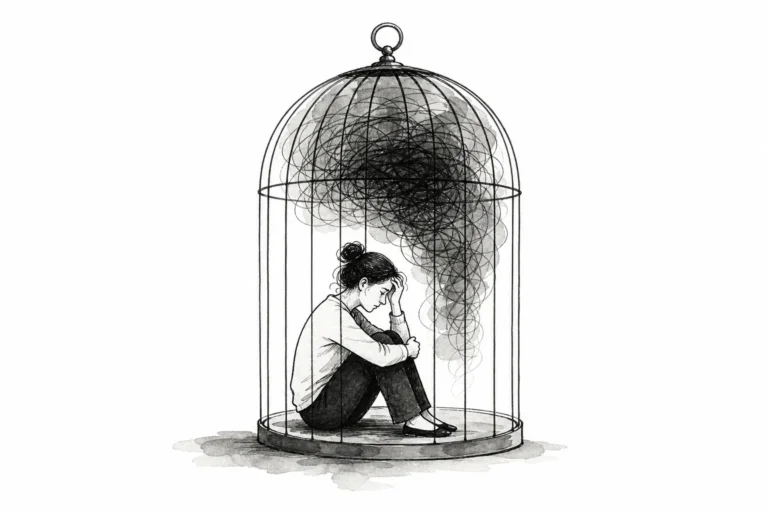
The problem is not effort or willpower. Most people stuck in anxiety cycles are deeply motivated and have done serious work. The problem is that some self-help mechanisms feed the anxiety loop instead of breaking it. Seeing how that happens changes the whole question.
Does Self-Help Actually Increase Anxiety Levels? What the Research Says
Flückiger’s meta-analysis looked at self-help interventions for depression, anxiety, and psychological distress across randomized controlled trials. For depression the findings were modest but statistically significant. For anxiety they were not. The pooled effect came in at SMD = -0.10, with confidence intervals crossing zero, which means the benefit over control conditions could not be reliably told apart from chance in that population.
Most self-help studies measure one thing: symptom reduction as the primary endpoint. The people who get worse, or who do not move at all despite heavy engagement, rarely make the headline. Trials are seldom built to capture who deteriorates, and adverse effects go underreported, so the research reads more reassuring than the lived experience of many readers. A study concluding “self-help works for some people” tells you almost nothing about whether it is safe or reliable for you.
The guided versus unguided split is where the data earns its keep. For generalized anxiety, meta-analyses comparing guided and unguided CBT self-help found a pooled effect of g = 0.16 favoring guided approaches right after treatment. The gap narrows at follow-up and is often not significant, but the direction holds across studies: guidance is the moderator that consistently lifts outcomes. Remove it, and results get smaller and more erratic. It is one of the clearest signals in the whole self-help versus therapy literature.
How Self-Help Practices Can Increase Anxiety Levels: The Mechanisms
Going from “harm is possible” to “here is exactly how” means looking at the psychology underneath the practices themselves. A few mechanisms show up again and again where self-help turns from useful into something that holds the problem in place.
Wegner’s Thought Suppression Paradox in Your Daily Practice
Daniel Wegner’s white bear experiment showed that telling someone not to think about something makes the thought rebound, more often, not less. People who suppressed thoughts of a white bear and were later told they could think freely thought about it far more than those who never tried to suppress it. That is the suppression paradox, and it lives inside ordinary self-help instructions. For an accessible outline of the rebound effect in unwanted thinking, see discussions of unwanted thoughts and rebound effects.
“Notice your anxious thoughts.” “Journal your worries.” “Identify your triggers.” Each one trains sustained attention on anxiety. The intent is to reduce distress, but the effect is to keep the nervous system pointed straight at it. In Wegner’s model, the act of monitoring the problem can confirm to the brain that the problem is worth monitoring, which can make the symptom louder in the people most prone to it.
The Self-Monitoring Trap: Rumination Dressed Up as Awareness
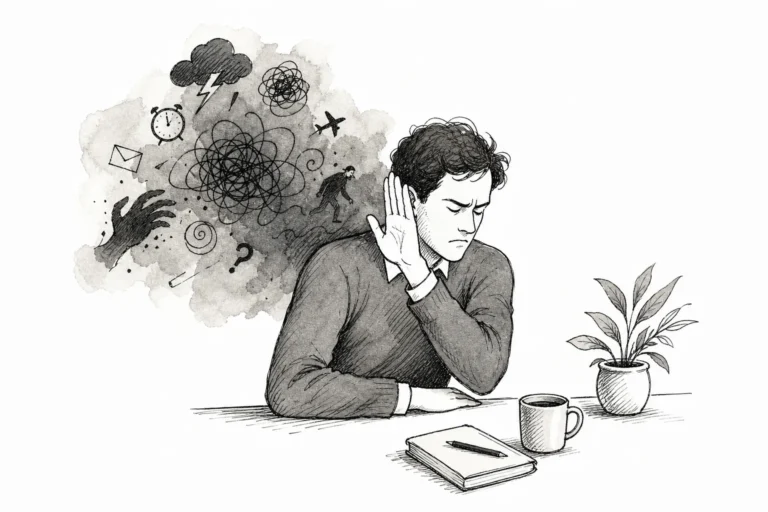
Mood tracking apps, symptom journals, “check in with yourself” prompts, these can work as hypervigilance wearing the language of insight. Someone scanning for signs of anxiety will find them. The body throws off thousands of sensations a day, and a trained self-monitor will read ambiguous physical noise as evidence of threat.
This is not a failure of the person doing it. It is the predictable outcome of sustained threat-scanning. Overthinking anxiety is a maintenance mechanism, not a way out. Calling it “awareness” does not change what it does to the nervous system. More methods simply mean more chances to conclude that something is wrong.
Perfectionism, Self-Improvement Pressure, and the Shame Spiral
The moment self-help becomes something you can fail at, the stakes around “getting better” stack a second anxiety on top of the first. The fix-yourself frame builds a performance context, and performance brings self-judgment, comparison, and shame when the technique does not deliver.
Hunting for a new technique after the last one failed feels like progress. Often it is the opposite. Each new method quietly adds to the evidence that you are not fixed yet, which is the exact belief self-help was supposed to dissolve. This kind of self-improvement anxiety is its own loop, and it is nearly invisible to the person inside it.
What Years of Practice Revealed That the Studies Hadn’t Named
Research data gives you averages. Working with people one at a time surfaces the patterns the averages bury. Across years of practice, working with hundreds of people on anxiety, one pattern kept repeating that no study had named directly: the people most diligent about their self-help were often the most locked into their anxiety. More technique use went with more symptom awareness, not less.
These were not passive or resistant people. They were the ones who had read the books, downloaded the apps, sat through the workshops, and applied the methods in good faith. Their diligence was the thing keeping the loop alive. That observation came first. The alignment with Wegner’s suppression findings and with the outcome variability in Flückiger’s data was obvious only once the research caught up to it.
Secondary Gains: The Hidden Reason Self-Help Doesn’t Stick
Secondary gains explain why technique-focused self-help can run for years without resolving. Anxiety, even when it genuinely hurts, can quietly do a job: holding an identity together, giving a legitimate reason to avoid a high-risk situation, shaping how people relate to you, drawing care and attention that might not arrive otherwise. None of this is manipulation. It runs below awareness.
Self-help that ignores the secondary gain is trying to pull a symptom while the function it serves stays untouched. The anxiety comes back because it is still being used for something. No breathing exercise reaches that. No journal prompt touches it. That is why the same patterns walk into the room year after year, whatever the person has already tried.
The argument at the center of Stop Fixing Yourself is that the self-help frame is not a neutral container for good tools. The frame is part of the problem. The book names the state that frame produces: the hidden trance. The book moves through recognition, destabilization, reframing, and integration of the anxiety pattern, built to be the last framework a reader needs rather than one more rung on the same ladder.
Self-Help That Doesn’t Backfire: What the Evidence Actually Supports
Walking away from the harmful mechanisms does not mean doing nothing. The evidence points clearly at what lowers the risk, and it lands on one variable: guidance.
Guided CBT self-help brings structured feedback, accountability, and an outside eye that catches misapplication before it does damage. Solo content consumption removes all three. Guided approaches outperform unguided ones modestly but consistently, probably not because the content differs, but because ongoing correction heads off the kind of sustained misuse that makes things worse over time. A workbook used wrong for six months can entrench the very problem it was meant to solve.
If guided self-help is what you can reach right now, a few safeguards lower the risk. Screen for real credentials and realistic claims, and treat bold promises as a reason to walk away. Keep its scope narrow, aimed at one specific issue rather than a whole life philosophy. Watch your honest response and treat worsening symptoms as data, not personal failure. Keep real support around you, a trusted person and not only a method. And decide in advance where the line is for moving to professional help, because the middle of a crisis is the worst moment to try to judge that clearly.
Clear Signs It’s Time to Stop Self-Helping
Recognizing these signs is not failure. It is accurate self-assessment, the one kind of self-monitoring that actually serves you. The technique has become a ritual that feels compulsory rather than helpful. You are spending more time thinking about anxiety than you did before you started. Symptoms have stalled or worsened despite months of steady effort. Shame shows up when a technique does not work. You are collecting new methods instead of staying with one. Your life is organizing itself around managing anxiety rather than living through it.
Any one of these is worth taking seriously. All of them together are an answer.
Working with someone offers what solo practice structurally cannot: another person who can catch a secondary gain you cannot see, correct course in real time, and tell the difference between a technique being misapplied and a technique being wrong for your pattern in the first place. Approaches that work with unconscious patterns, rather than trying to override them, go at why the pile of techniques keeps growing instead of adding to it.
When the Fix Is the Problem
The research, the work with real people, and Wegner’s suppression paradox all land on the same point: anxiety can be held in place by the sustained effort to remove it. The reader who has tried everything and still feels stuck is not failing at self-help. They are living out exactly what the evidence predicts.
So does self-help actually increase anxiety? For some people, under specific conditions, yes, not through bad advice, but through the structural pressure of constant self-monitoring, suppression, and shame. The fix-yourself frame can manufacture the very conditions that keep anxiety alive. The alternative is not a sharper technique. It is a different frame entirely.
If you recognize your own pattern here, Stop Fixing Yourself by Timoteo Crnković was written for that recognition. The first chapter is free by email, no strings. For anyone who wants to work with someone directly rather than read another book, one-on-one online sessions are available worldwide. Either way the starting point is the same: stop treating the effort to fix yourself as neutral. It isn’t.