Why trying to fix anxiety makes it worse, not better
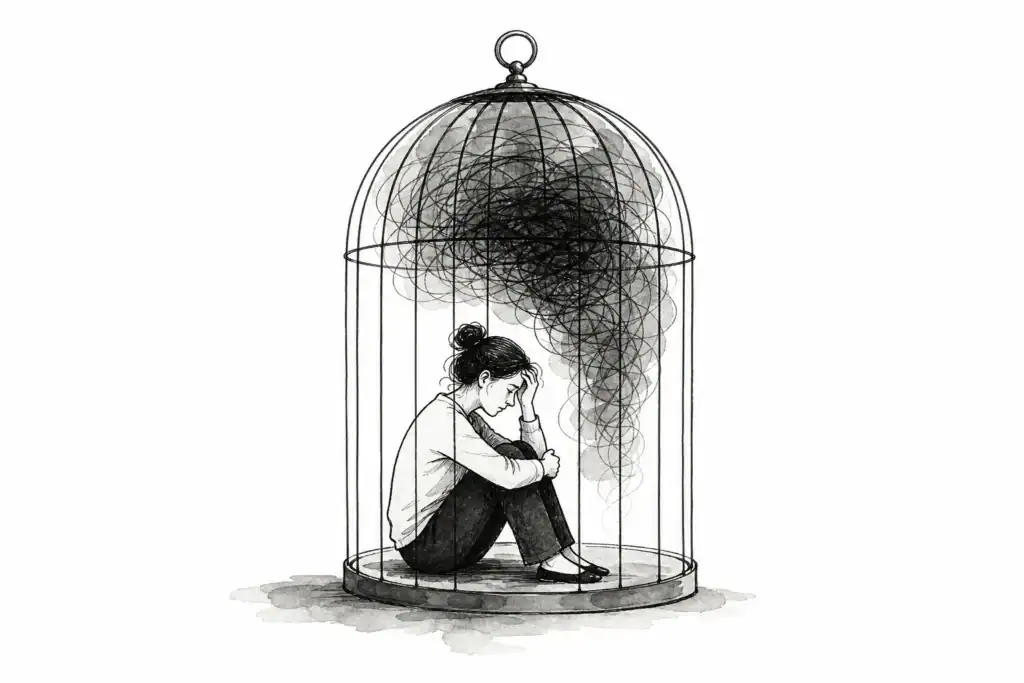
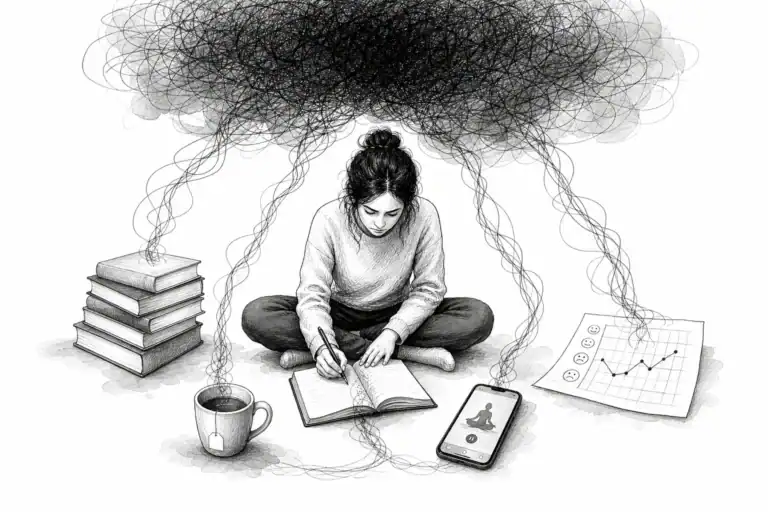
If you’ve ever wondered why trying to fix anxiety makes it worse instead of better, you’ve finally asked the right question. You’ve breathed through it. Journaled about it. Pushed through it on the bad mornings and told yourself the good ones meant progress. You downloaded the apps, followed the routines, read at least a few of the books. And the anxiety is still here. Often louder than before. If that’s where you are, you haven’t failed at anything. You’re inside a pattern nobody bothered to explain to you.
Trying to get rid of anxiety is not a neutral act. It works as a trigger. Suppression, safety behaviors, the constant reaching for reassurance, all of it sends one signal down into your nervous system: the threat is real and it isn’t over yet. The fixing becomes the fuel.
This is the spine of Timoteo Crnković’s book Stop Fixing Yourself, drawn from years of work with people across more than a thousand hours of Ericksonian hypnotherapy sessions. It asks the one question most anxious people are never asked: what if the effort to fix the problem is the thing keeping it alive? The answer holds up against published research and direct observation, though, like most things in psychology, the picture is layered rather than absolute.
Why trying to fix anxiety makes it worse: the suppression paradox
What the white bear experiment reveals
In the late 1980s, psychologist Daniel Wegner ran a set of now-famous experiments on thought suppression (Wegner et al., 1987). Participants were told not to think about a white bear. What happened next was the opposite of what anyone intended: once the suppression period ended, they reported more white-bear thoughts than people who were simply told to think about it from the start. Meta-analytic evidence puts the rebound effect at real but modest, and whether it shows up depends on emotional content, individual differences, and context. For the primary source, see the original thought-suppression research on Wegner’s experiments.
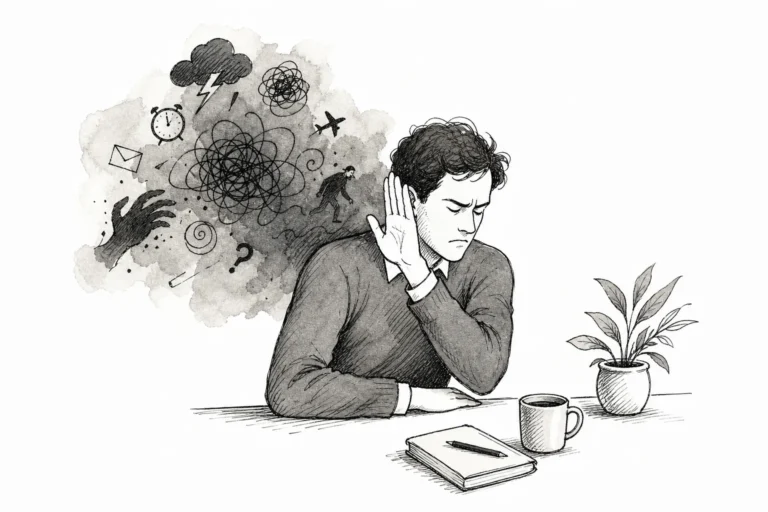
The reason isn’t a flaw in your character. When you order your mind to suppress a thought, your monitoring system has to keep searching for that thought so it knows when to do its job. The search keeps the signal warm. Now apply it to anxiety: the moment you try not to feel anxious, part of your brain starts scanning for anxiety. That scan is the problem. Clinicians have long described how unwanted thoughts persist no matter how firmly you wave them off; the APA’s discussion of intrusive thinking offers useful context on intrusive and unwanted thoughts.
Later research suggests the rebound runs stronger for emotionally loaded material, which is exactly what an anxious thought is. Wenzlaff and colleagues found that people suppressing anxious or depressive thoughts showed marked jumps in intrusive thinking. The research isn’t perfectly uniform, and newer work shows outcomes hinge on the person and the strategy they use. Still, the pattern is steady enough to take seriously: suppression tends to increase the very thing you’re trying to erase, especially when that thing carries emotional weight.
How suppression creates meta-anxiety and the effort-resistance loop
There’s a second layer underneath. Once getting rid of anxiety becomes the goal, every return of the feeling reads as proof you failed. That sense of failure generates its own distress, stacked on top of the original. This is meta-anxiety: anxiety about being anxious. Anyone who has struggled for years knows the texture of it, even without a name for it.
Then the effort-resistance loop tightens everything. Fighting an internal experience is itself an arousal event. It lights up the same system you’re trying to calm. The harder you push against the anxiety, the more activation you make. This isn’t weakness. It’s how the machinery runs, and it’s why trying harder usually produces a worse result over time, not a better one.
Secondary gains: the hidden reason the cycle continues
What secondary gains actually mean in practice
Plenty of people understand the suppression paradox completely and stay anxious anyway. One reason is secondary gains, the quiet functions the anxiety performs. Nobody picks these on purpose. Anxiety can hand you a sense of certainty inside an uncertain situation. It can be a reason to put off a decision that feels dangerous. It can shield you, socially, from expectations you aren’t ready to meet. None of this is blame. It’s pattern recognition.
The nervous system keeps states that serve a purpose, even painful ones. This sits at the center of Stop Fixing Yourself, because it explains the thing ordinary self-help almost never touches: why honest effort, applied for months, still doesn’t move anything.
Why recognizing this pattern is the actual shift
Fixing anxiety while the secondary gains stay in the dark is like trying to drop a habit while the job it does for you goes unexamined. The system reinstalls whatever it hasn’t found a replacement for. That’s not a defect in you. It’s the logic of how a nervous system protects itself. Research on secondary gains and treatment outcomes points one way: people who quietly expect some indirect benefit from their symptoms can show worse outcomes, and many never say a word about it to their clinician (Fishbain et al., 1995). The findings aren’t uniform, but there’s enough behind the pattern to make it worth your attention.
For most people reading this, the reframe should land as relief. The techniques didn’t fail because you’re broken or short on willpower. They failed because they aimed at the symptom while the function underneath it stayed intact, and unexamined.
The everyday habits that quietly maintain the worry loop
Safety behaviors and reassurance-seeking in disguise
Safety behaviors are the small, mostly invisible moves you make to bring anxiety down in the moment. Checking the stove one more time. Googling a symptom to rule out the worst. Choosing the seat near the exit. Each one feels reasonable, because each one does lower the distress, for a few seconds.
The trouble is what that brief relief teaches. A safety behavior confirms the message that the threat was real and the escape was necessary. Reassurance-seeking runs on the same wiring: the relief is genuine, and it quietly trains the system to believe relief lives outside you, never inside your own capacity to sit with the feeling. CBT research on safety behaviors keeps finding the same thing, that gradually dropping them tracks with lower symptom severity in generalized anxiety and social anxiety alike (Salkovskis et al., 1999).
Experiential avoidance and why trying to fix anxiety makes it worse over time
Underneath the specific safety behaviors sits a wider habit that acceptance and commitment therapy calls experiential avoidance: the reflex to escape an uncomfortable inner state, whether it’s a thought, a sensation, an emotion, a memory. ACT defines it as an unwillingness to stay in contact with aversive private experience, plus all the effort spent changing its shape or frequency. In plain language, it’s the ongoing work of not feeling what you feel.
The worry loop feeds on that avoidance. You dodge a situation or a sensation, the distress dips, the dodging gets rewarded. The lesson that the experience was survivable never arrives, because you never stayed long enough to learn it. The same loop shows up across generalized anxiety, panic, social anxiety, health anxiety. It runs mostly below awareness, which is the whole reason naming it changes anything.
Why acceptance is not the same as giving up
What ACT and clinical research say about acceptance-based approaches
The first time someone hears “stop fighting the anxiety,” the objection is almost always the same: acceptance sounds like surrender. It isn’t. Acceptance here means noticing an experience without escalating it into an emergency that demands an instant response. It’s a drop in resistance, not a yes to suffering.
The evidence behind acceptance-based work is substantial. A systematic review of 23 randomized controlled trials found that ACT, mindfulness-based cognitive therapy, and mindfulness-based stress reduction all produced meaningful anxiety reductions against treatment as usual, with ACT and MBCT landing comparable to CBT on anxiety outcomes (Ost, 2014). For a fuller picture across anxiety disorders, see this systematic review of acceptance-based therapies. Long-term research is still maturing, and no single approach fits everyone. What the evidence does back is this: learning to stand in a different relationship to anxious experience, rather than swinging at it, is a credible path for a great many people.
The difference between feeling anxious and fighting anxiety
This is the line the whole article has been walking toward. Anxiety as a sensation is uncomfortable and survivable. Anxiety plus the frantic campaign to get rid of it is the actual problem. When you can feel anxious without treating it as a fire that needs putting out, the physiological loop starts slowing on its own. The shift asks for the release of an old compulsion, not the addition of a new technique.
This is the heart of Stop Fixing Yourself: the change isn’t a behavior you take on. It’s the dissolving of the urge to fix. That sounds simple. It isn’t easy, not after years of training in the opposite direction. But it’s the one move that stops pouring fuel on the system.
What to do instead: the case for stopping the fix
Stop Fixing Yourself as a way of seeing, not another technique
Crnković’s book moves through four phases: recognition, destabilization, reframing, and integration of the anxiety pattern. It isn’t a drawer of coping strategies. It’s built to dismantle the need for them by going at the mechanism underneath. The work draws on Wegner’s suppression research, secondary gains, and the Rapid Mental Reset approach, shaped from direct work with people rather than theory applied from a distance. Independent review of this particular approach is still limited, as it is with most proprietary work; its foundations rest on well-established ground from ACT, CBT, and Ericksonian hypnotherapy. For readers who want the underlying evidence laid out, see the Science behind the book.
A sample first chapter is available by email, and the choice to keep it that quiet is deliberate. It follows the book’s own argument: the last thing a person worn out by the self-help cycle needs is one more funnel pulling them deeper in. A short video overview is there too, for anyone who prefers the brief version.
When working with someone directly helps
Reading about these mechanisms does real work on its own, and for some people recognition alone brings noticeable relief. When the safety behaviors are everywhere, when the secondary gains run deep, or when the cycle has been turning for years, working with someone one-on-one moves things faster than reading can. The patterns sharpen when a trained eye can watch them happen in real time.
Timoteo Crnković, author and conversational hypnotherapist works with people online, which keeps the approach within reach wherever you are. The sessions stay inside the same frame as the book: not stacking on new techniques, but finding and dissolving the patterns that kept the old ones from ever holding. For people who have sat across from therapists before and still left without resolution, the sessions go at the mechanism level, suppression, avoidance, secondary gains, the layer standard approaches may never have aimed at directly. For readers who want ongoing research on long-term outcomes, see recent work on durability and recovery examining long-term outcomes.
The pattern nobody explained to you
Go back to the person who has tried everything. The breathing, the journaling, the reframing, the therapy, the apps. None of it held. That isn’t failure. It’s the predictable result of a system nobody drew for you. The suppression paradox, the effort-resistance loop, the secondary gains keeping the cycle fed, the safety behaviors confirming the threat, none of it was in the instructions you were handed.
This is why trying to fix anxiety makes it worse: the fight itself confirms the danger. The nervous system reads your struggle as evidence that something threatening is here. The state you occupy while struggling has a name: the hidden trance. Stopping the fix isn’t passivity. For a lot of people it turns out to be the only move that stops handing the system more fuel to burn.
If you want the explanation behind why nothing has worked so far, Stop Fixing Yourself is where that conversation begins, naming the mechanism instead of chasing the symptom.