Thought suppression effect: why fighting thoughts backfires
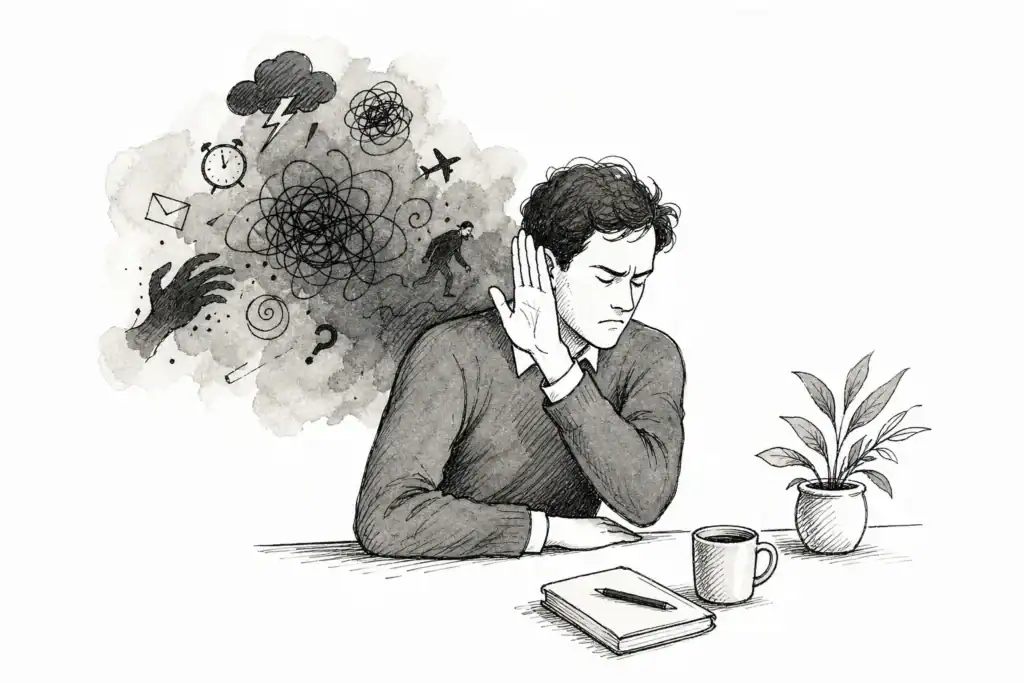
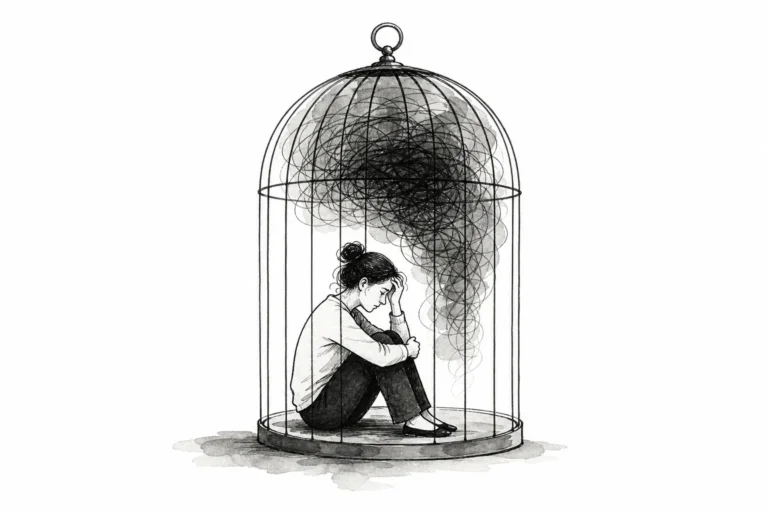
You lie awake at 1 a.m. telling yourself to stop replaying that conversation. You spend an anxious afternoon firmly deciding not to think about the test results. And the thought comes back louder, more insistent, practically fluorescent. That is the thought suppression effect: the well-documented finding that deliberately trying to keep a thought out of awareness tends to make it more accessible, not less.
This is not a personal failing. It is built into the architecture of mental control itself. It is also one of the mechanisms Timoteo Crnković returns to throughout Stop Fixing Yourself, drawn from years of work with people on exactly this pattern, because it names something most anxious people feel but cannot place: the techniques meant to manage their thoughts are the thing keeping the problem alive. What follows is the science of why that happens, and what the research points to instead.
What the thought suppression effect actually is
The thought suppression effect is what happens when resistance to a thought makes that thought more present, not less. This is not ordinary forgetting. Forgetting is passive, the thought just fades. Suppression is the opposite of passive: a deliberate, effortful attempt to block specific mental content. The effort is where the trouble starts.
Daniel Wegner’s ironic process theory is the most widely accepted explanation. He proposed two processes running at once: an operating process that consciously steers attention away from the unwanted thought, and a monitoring process that quietly scans for any sign the thought has come back. The monitor is the trap. When you are rested and calm, the two roughly balance. Drop your cognitive resources through stress, fatigue, or distraction, and the operating process tires while the monitor keeps running at full speed. The thought floods back, often stronger than before you started. You did not fail at it. The machine is built this way.
The white bear experiment: what Wegner’s research showed
In 1987, Wegner and colleagues ran the study that made this concrete. Participants spoke their stream of consciousness aloud while told not to think of a white bear, ringing a bell each time it appeared. They reported the bear more than once a minute. The telling part came next: the group that first suppressed the thought and was then told to think freely reported the bear far more often than people told to think about it from the start. Suppression had charged the thought with extra accessibility. The original procedures are laid out in an accessible overview of the white bear experiment.
A second condition from the same study tends to get misread. When participants were handed one specific thing to think about instead, a red Volkswagen, intrusions during suppression fell, and so did the rebound. This gets quoted as proof that distraction works. It shows something narrower. The thought was never the problem. The problem was the scanning loop, the monitor with nothing to do but hunt. Give the mind one concrete occupation and the loop loses its grip for a while. That is not a cure. It is a temporary interruption of the same mechanism, and the moment the occupation ends, the monitor is right where it was.
Short-term relief versus what happens next
Here is the part most explanations skip, and skipping it makes the rest hard to believe. Suppression works in the short term. While the effort is active, intrusive thoughts go down. Anyone who has pushed a thought away and felt the brief quiet is not imagining it. That quiet is real, and it is exactly what makes the habit so hard to break. The reward lands immediately. The bill arrives later.
When the effort stops, or the load goes up, the monitor takes over and the thought returns above where it started. The clinical picture is more tangled than it first looks: recent meta-analyses find rebound effects that are often small and inconsistently replicated, while research on OCD, anxiety, and PTSD does steadily link heavier suppression with higher symptom severity. In PTSD especially, suppressing trauma-related material is among the more reliable markers of a symptom load that will not lift, though the size of the effect moves around between studies. Plainly put: suppression works until it doesn’t, and when it breaks it tends to break harder than if you had never reached for it.
The brief relief is the whole reason people keep using the strategy long after it stops helping: the mind remembers the quiet and reaches for the same lever again, while the larger pattern quietly gets worse.
How the thought suppression effect maps onto anxiety, OCD, and PTSD
In anxiety and OCD, intrusive thoughts are not just uncomfortable, they are the thing the person is trying hardest to suppress. That makes a closed loop. Studies consistently tie heavier suppression to more severe OCD symptoms, not as one clean cause but as a maintenance factor: the suppression keeps the thoughts loud and keeps them stinging. The person working hardest not to think about contamination, harm, or doubt is training the monitor to find those exact thoughts faster. The effects in this research run small to moderate and shift with study design, but the direction holds across reviews.
PTSD follows the same shape. Suppressing trauma memories predicts ongoing anxiety and low mood, even in studies that account for other coping styles. The memory does not leave because you hold it at arm’s length. It gathers pressure. The evidence supports suppression as a real maintenance variable here, one of several, not the whole story.
There is one more layer worth naming. Suppressed material can get harder to recall over time, which sounds like progress. It isn’t. Work using Think/No-Think paradigms suggests that content pushed down rather than worked through can keep shaping behavior and feeling even when you cannot consciously reach it, though the evidence for those hidden influences is still building. It is examined in focused work on suppression-induced forgetting. The thing did not resolve. It moved somewhere harder to reach. Forgetting a wound is not the same as healing it, and mistaking one for the other is a large part of why so many people stay stuck after years of honest effort.
Why anxiety management techniques so often become the problem
Most conventional anxiety tools share a feature nobody says out loud. Thought-stopping, distraction drills, certain grounding exercises, all of them carry the same instruction underneath: move attention off the unwanted thought. When that is the aim, it is suppression wearing a technique. Not every tool works this way. Breath work and some kinds of journaling can do the opposite, letting material be felt and processed rather than pushed off. But wherever the goal is “make this thought go away,” the monitor is already scanning for failure, and the rebound is waiting no matter how the method is dressed.
This is the pattern Timoteo Crnković, author and conversational hypnotherapist, watched repeat across years of practice and set down in Stop Fixing Yourself. The book uses Wegner’s research and the suppression paradox to explain why technique-driven anxiety management buys a little quiet and then cycles worse. The Rapid Mental Reset approach he describes works by recognizing and dissolving the underlying pattern rather than asking anyone to push a thought away or swap it for a nicer one: it removes the conditions that made suppression feel necessary in the first place. More of the research behind it sits on the Science behind the book page.
The distinction is the whole thing. This is not about adding a better technique to the pile. It is about seeing why the pile keeps growing and never holds.
Thought suppression effect research: what the evidence supports instead
Acceptance and Commitment Therapy and mindfulness-based approaches show stronger results than suppression on intrusive thoughts, in both healthy and clinical groups. The active ingredient is not relaxation or positive spin. It is the drop in struggle with the thought itself. Stop resisting the thought and the monitor has no failure to hunt for, so the conditions that produce ironic rebound largely fall away. Defusion, a core ACT move, treats a thought as a mental event rather than a fact demanding action. Acceptance lets the thought be there without ranking its presence as a problem to fix.
These work not because they are cleverer forms of suppression, but because they walk out of the suppression dynamic completely. They change the relationship to the thought instead of attacking the thought. That is where the evidence converges, and it lines up with the line running through both Wegner’s work and the Stop Fixing Yourself framework: relief comes from removing effort, not piling on more. Neuroscience has also started to map the biology of when people can successfully inhibit unwanted thoughts; for a readable summary, see the reporting on the team that identified a mechanism that helps us inhibit unwanted thoughts.
The thought suppression effect is not a bug in how the mind runs. It is a signal that someone has been working against themselves. In Stop Fixing Yourself, that working-against-yourself state has a name: the hidden trance. Reading that signal, instead of engineering a smoother way to ignore it, is where real change starts.
The one thing worth taking from this
Most people who struggle with intrusive or anxious thoughts have been told, out loud or between the lines, to try harder. Manage it better. Suppress it more consistently. Catch the negative thought and replace it with a positive one before it lands. The evidence here explains why that advice tends to make things worse. The monitor is too efficient to fool, and the harder you push, the bigger the thing that comes back.
Understanding the suppression effect lands as relief for people who felt the trap for years without a name for it. The way out is not a sharper suppression technique. It is stepping out of the suppression game. That is a genuinely different instruction, and for anyone who has spent years cycling through anxiety tools, it is a disorienting one. Stop Fixing Yourself applies it directly to anxiety that will not let go, grounded in the research, rather than offering one more method to layer on. The first chapter is the book, a fair place to start if the premise of this article felt a little too familiar.