The Hidden Trance: The State That Keeps Anxiety Alive
The anxiety survived everything you threw at it. It survived the breathing exercises, the journals, the courses, the affirmations, and every promise that the next method would be the one. It survived because none of those methods touched the state you were in while using them. That state has a name.
The hidden trance is a state of absorbed, automatic attention in which a person continuously monitors, evaluates, and tries to repair their own inner experience. It feels like self-awareness and responsibility. It functions as hypnosis: a narrowed focus organized around a single accepted suggestion, the idea that something inside you is wrong and needs fixing. The term comes from the book Stop Fixing Yourself: The Hidden Trance That Keeps Anxiety Alive by Timoteo Crnković, and this article is its full definition.
Trance means something simpler than you think

Forget the swinging watch. In the Ericksonian tradition of hypnotherapy, a trance is an ordinary state with three features: attention narrows onto one thing, awareness of everything outside that thing fades, and responses start running automatically. Milton Erickson spent his career pointing out that people drift in and out of such states all day. You drive twenty minutes and remember nothing of the road. You look up from your phone and forty minutes are gone. A film ends and for a few seconds the room feels unfamiliar.
Nothing about those states is exotic. What makes a trance consequential is the suggestion it carries. A film carries a story, and when the film ends the story ends with it. The hidden trance carries something stickier: a claim about who you are. And unlike a film, it has no credits. It runs in the background for years, and the person inside it calls it working on myself.
How the hidden trance forms

It begins with a sentence that gets accepted without examination. Something is wrong with me. The sentence usually arrives at a vulnerable moment: the first panic attack, a stretch of insomnia, a breakup, a season of comparing yourself to people who seemed to be doing life correctly. Vulnerable moments are precisely when the mind is most open to suggestion. Hypnotherapists build careful inductions to create that openness on purpose… life creates it by accident, and then delivers the worst possible sentence into it.
Once accepted, the sentence behaves like a post-hypnotic suggestion. It directs behavior while staying out of sight. Buying the self-help book obeys it. The 5 a.m. routine obeys it. Checking your chest for tightness before you are fully awake obeys it. Every act of fixing carries the same silent premise, and every repetition confirms the premise a little more deeply. The fixing is not a response to the trance: the fixing is the trance, performed.
This is why the person rarely notices. A trance is hard to see from inside, and this one disguises itself as virtue. Self-monitoring looks like mindfulness. Symptom research looks like education. The growing shelf of methods looks like commitment. From outside, a pattern is visible. From inside, there is only the next honest attempt.
The loop, in slow motion
Three mechanisms keep the trance running, and each has research behind it.
The first is monitoring. When your goal is to catch anxiety early, part of your mind scans for it continuously, and a scanner tuned to threat will find threat in ordinary bodily noise. Daniel Wegner’s work on the thought suppression effect showed the machinery: the monitoring process that checks whether an unwanted thought is gone keeps that exact thought warm and accessible. Inside the hidden trance, monitoring feels like vigilance. In practice it is rehearsal.

The second is the fix itself. Every technique deployed against anxiety sends one message down into the nervous system: the threat is real and it is still here. Suppression, safety behaviors, and reassurance-seeking all confirm the danger they are meant to manage, which is why trying to fix anxiety makes it worse over time rather than better. Inside the trance, each failed technique reads as personal failure, and personal failure feeds the founding suggestion… something really must be wrong with me, look how nothing works.
The third is the industry built on top of the first two. Self-improvement content supplies an endless stream of new methods, and each new method quietly restates the premise that you need one. The evidence on self-help and anxiety is sobering: pooled effects on anxiety are small and, in the landmark meta-analysis, statistically indistinguishable from chance. For someone in the hidden trance, that stream of methods works like a hypnotist who never stops talking.
Signs you are in the hidden trance
You rate your days. You check your body before you are fully awake. A calm week makes you suspicious, because calm means the anxiety must be planning something. You know more about anxiety than about any hobby you have. Decisions wait until you feel ready, and ready keeps moving. There is a technique for every situation, and a backup technique for when the first one fails. Somewhere along the way, getting better became the project of your life… and life became the thing scheduled to start afterward.
One more sign outranks the rest. Reading a list like this, your first instinct was to use it: to score yourself, to add it to the file, to fold it into the project. That instinct is the trance reaching for new material. It can absorb anything, including descriptions of itself.
Why more effort deepens it
Here the hypnotic frame stops being a metaphor and starts doing real explanatory work. In hypnosis, effort exerted inside the frame deepens the frame. A person told their arm is too heavy to lift will push against the heaviness, and the pushing itself becomes proof of it. The hidden trance runs on the same physics. Working harder on yourself is effort inside the frame of something is wrong with me, so the harder you work, the more real the wrongness feels.
This resolves the puzzle that brings most people to this site. The most diligent people are often the most stuck. Their diligence was never the missing ingredient: it was the deepening mechanism. Escaping a trance using the trance’s own logic tightens it, the way struggling in deep water exhausts a swimmer faster than the water does.
What breaks a trance

A trance ends by interruption, and interruption starts with recognition. The moment a suggestion is seen as a suggestion, it loses its automatic quality. It becomes a sentence someone once accepted rather than a fact about the world, and a sentence can be examined in a way a fact never invites. Some people feel a real shift at exactly this point: the frame becomes visible, and a visible frame stops organizing everything inside it.
For patterns that have run for years, recognition usually needs help from outside the frame, because the mind doing the recognizing is the same mind the trance has been training. This is where Ericksonian work turns inside out. The classical picture has a hypnotherapist inducing trance in a client who arrives in a normal state. Here the client arrives already hypnotized, absorbed for years in the suggestion that they are broken, and the work runs in the opposite direction: pattern interruption, reframing, and the deliberate dismantling of the founding suggestion. Less an induction than a waking up. Timoteo Crnković, author and conversational hypnotherapist, works with people online in exactly this frame, and the research foundations behind the approach are laid out on the Science behind the book page.
One warning belongs here, and the book states it bluntly. Breaking the hidden trance can itself be recruited as the next self-improvement project. The person who spent years collecting techniques will happily collect de-hypnosis as technique number forty-one. The way this work stays honest is by subtraction: it removes the compulsion to fix rather than installing a better fix. If an approach hands you homework, daily exercises, and a progress tracker for escaping the trance of self-monitoring… it has already lost the plot.
Where the term comes from
The hidden trance is the central concept of Stop Fixing Yourself: The Hidden Trance That Keeps Anxiety Alive, first published in Croatian as Prestani raditi na sebi and drawn from years of Ericksonian hypnotherapy practice with people whose anxiety had outlasted every method they tried. The book moves through recognition, destabilization, reframing, and integration of the pattern, and it carries no techniques, no exercises, and no steps… by design, for the reasons this article has laid out. The first chapter is available free by email.
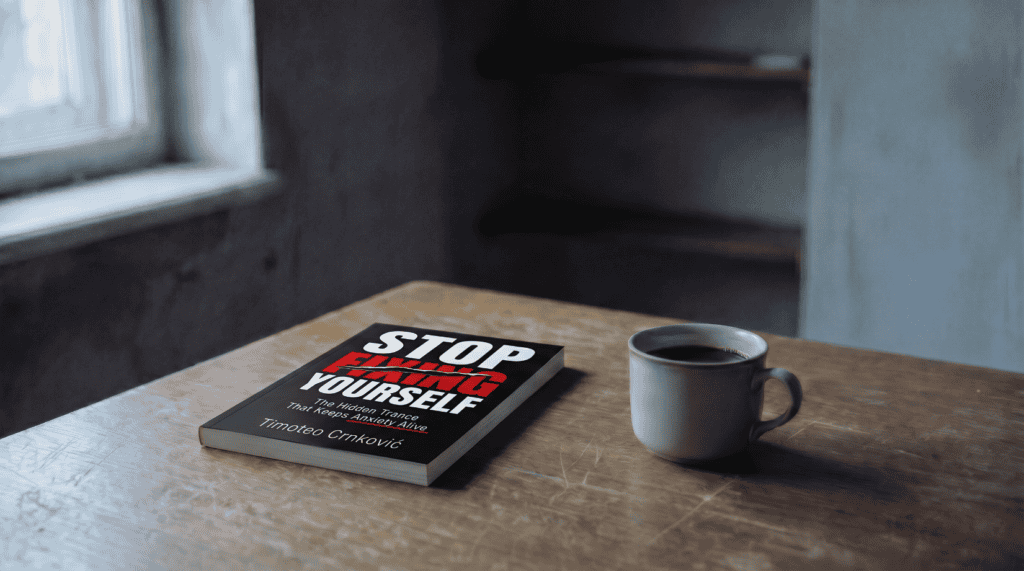
If this article read less like new information and more like a description of your last few years, that recognition is where the work begins. The book continues it.
Frequently asked questions about the hidden trance
What is the hidden trance?
The hidden trance is a state of absorbed, automatic attention in which a person continuously monitors and tries to repair their own inner experience. It is organized around one accepted suggestion, the belief that something inside is wrong and needs fixing, and it keeps anxiety alive by treating every sensation as evidence for that belief. The term was introduced by Timoteo Crnković in the book Stop Fixing Yourself.
Is the hidden trance the same as hypnosis?
It is an everyday form of it. In the Ericksonian view, a trance needs only narrowed attention, faded peripheral awareness, and automatic responding, and those three arise naturally whenever a suggestion gets accepted at a vulnerable moment. A stage, an induction, or a hypnotist are optional. Life supplies the induction on its own.
What keeps the hidden trance running?
Three mechanisms: constant self-monitoring, which keeps the anxious signal warm; the fixing itself, which confirms to the nervous system that a threat is real; and the steady supply of new self-improvement methods, each of which restates the premise that you need one. Effort inside the trance deepens the trance, which is why the most diligent people are often the most stuck.
How do I know if I am in the hidden trance?
Common signs include rating your days, scanning your body for symptoms before fully waking, feeling suspicious of calm periods, postponing decisions until you feel ready, and organizing life around getting better rather than living. The strongest sign is the instinct to turn even this description into new self-improvement material.
How does the hidden trance end?
By interruption rather than force. When the founding suggestion is recognized as a suggestion instead of a fact, it loses its automatic power. Long-running patterns usually need help from outside the frame, which is the direction of Ericksonian work described in Stop Fixing Yourself: dismantling the pattern instead of adding techniques on top of it.
Does Self-Help Actually Increase Anxiety? The Evidence
Most people arrive here carrying a quiet suspicion they have not said out loud: that all the journals, apps, breathing exercises and books have somehow made the anxiety worse, not better. They tried harder. The anxiety is still there, sometimes heavier than before they started. That suspicion deserves a straight answer, not reassurance.
The research on self-help is messier than the wellness industry admits. A landmark meta-analysis of self-help interventions found that, pooled across studies, the effect on anxiety was small, a standardized mean difference of just -0.10, and it failed to reach statistical significance. The picture changes once you separate guided from unguided approaches. What gets sold as one category, “self-help,” is really two different things, and treating them as one has led a lot of people to the wrong conclusion about what works.
The problem is not effort or willpower. Most people stuck in anxiety cycles are deeply motivated and have done serious work. The problem is that some self-help mechanisms feed the anxiety loop instead of breaking it. Seeing how that happens changes the whole question.
Does Self-Help Actually Increase Anxiety Levels? What the Research Says
Flückiger’s meta-analysis looked at self-help interventions for depression, anxiety, and psychological distress across randomized controlled trials. For depression the findings were modest but statistically significant. For anxiety they were not. The pooled effect came in at SMD = -0.10, with confidence intervals crossing zero, which means the benefit over control conditions could not be reliably told apart from chance in that population.
Most self-help studies measure one thing: symptom reduction as the primary endpoint. The people who get worse, or who do not move at all despite heavy engagement, rarely make the headline. Trials are seldom built to capture who deteriorates, and adverse effects go underreported, so the research reads more reassuring than the lived experience of many readers. A study concluding “self-help works for some people” tells you almost nothing about whether it is safe or reliable for you.
The guided versus unguided split is where the data earns its keep. For generalized anxiety, meta-analyses comparing guided and unguided CBT self-help found a pooled effect of g = 0.16 favoring guided approaches right after treatment. The gap narrows at follow-up and is often not significant, but the direction holds across studies: guidance is the moderator that consistently lifts outcomes. Remove it, and results get smaller and more erratic. It is one of the clearest signals in the whole self-help versus therapy literature.
How Self-Help Practices Can Increase Anxiety Levels: The Mechanisms
Going from “harm is possible” to “here is exactly how” means looking at the psychology underneath the practices themselves. A few mechanisms show up again and again where self-help turns from useful into something that holds the problem in place.
Wegner’s Thought Suppression Paradox in Your Daily Practice
Daniel Wegner’s white bear experiment showed that telling someone not to think about something makes the thought rebound, more often, not less. People who suppressed thoughts of a white bear and were later told they could think freely thought about it far more than those who never tried to suppress it. That is the suppression paradox, and it lives inside ordinary self-help instructions. For an accessible outline of the rebound effect in unwanted thinking, see discussions of unwanted thoughts and rebound effects.
“Notice your anxious thoughts.” “Journal your worries.” “Identify your triggers.” Each one trains sustained attention on anxiety. The intent is to reduce distress, but the effect is to keep the nervous system pointed straight at it. In Wegner’s model, the act of monitoring the problem can confirm to the brain that the problem is worth monitoring, which can make the symptom louder in the people most prone to it.
The Self-Monitoring Trap: Rumination Dressed Up as Awareness
Mood tracking apps, symptom journals, “check in with yourself” prompts, these can work as hypervigilance wearing the language of insight. Someone scanning for signs of anxiety will find them. The body throws off thousands of sensations a day, and a trained self-monitor will read ambiguous physical noise as evidence of threat.
This is not a failure of the person doing it. It is the predictable outcome of sustained threat-scanning. Overthinking anxiety is a maintenance mechanism, not a way out. Calling it “awareness” does not change what it does to the nervous system. More methods simply mean more chances to conclude that something is wrong.
Perfectionism, Self-Improvement Pressure, and the Shame Spiral
The moment self-help becomes something you can fail at, the stakes around “getting better” stack a second anxiety on top of the first. The fix-yourself frame builds a performance context, and performance brings self-judgment, comparison, and shame when the technique does not deliver.
Hunting for a new technique after the last one failed feels like progress. Often it is the opposite. Each new method quietly adds to the evidence that you are not fixed yet, which is the exact belief self-help was supposed to dissolve. This kind of self-improvement anxiety is its own loop, and it is nearly invisible to the person inside it.
What Years of Practice Revealed That the Studies Hadn’t Named
Research data gives you averages. Working with people one at a time surfaces the patterns the averages bury. Across years of practice, working with hundreds of people on anxiety, one pattern kept repeating that no study had named directly: the people most diligent about their self-help were often the most locked into their anxiety. More technique use went with more symptom awareness, not less.
These were not passive or resistant people. They were the ones who had read the books, downloaded the apps, sat through the workshops, and applied the methods in good faith. Their diligence was the thing keeping the loop alive. That observation came first. The alignment with Wegner’s suppression findings and with the outcome variability in Flückiger’s data was obvious only once the research caught up to it.
Secondary Gains: The Hidden Reason Self-Help Doesn’t Stick
Secondary gains explain why technique-focused self-help can run for years without resolving. Anxiety, even when it genuinely hurts, can quietly do a job: holding an identity together, giving a legitimate reason to avoid a high-risk situation, shaping how people relate to you, drawing care and attention that might not arrive otherwise. None of this is manipulation. It runs below awareness.
Self-help that ignores the secondary gain is trying to pull a symptom while the function it serves stays untouched. The anxiety comes back because it is still being used for something. No breathing exercise reaches that. No journal prompt touches it. That is why the same patterns walk into the room year after year, whatever the person has already tried.
The argument at the center of Stop Fixing Yourself is that the self-help frame is not a neutral container for good tools. The frame is part of the problem. The book names the state that frame produces: the hidden trance. The book moves through recognition, destabilization, reframing, and integration of the anxiety pattern, built to be the last framework a reader needs rather than one more rung on the same ladder.
Self-Help That Doesn’t Backfire: What the Evidence Actually Supports
Walking away from the harmful mechanisms does not mean doing nothing. The evidence points clearly at what lowers the risk, and it lands on one variable: guidance.
Guided CBT self-help brings structured feedback, accountability, and an outside eye that catches misapplication before it does damage. Solo content consumption removes all three. Guided approaches outperform unguided ones modestly but consistently, probably not because the content differs, but because ongoing correction heads off the kind of sustained misuse that makes things worse over time. A workbook used wrong for six months can entrench the very problem it was meant to solve.
If guided self-help is what you can reach right now, a few safeguards lower the risk. Screen for real credentials and realistic claims, and treat bold promises as a reason to walk away. Keep its scope narrow, aimed at one specific issue rather than a whole life philosophy. Watch your honest response and treat worsening symptoms as data, not personal failure. Keep real support around you, a trusted person and not only a method. And decide in advance where the line is for moving to professional help, because the middle of a crisis is the worst moment to try to judge that clearly.
Clear Signs It’s Time to Stop Self-Helping
Recognizing these signs is not failure. It is accurate self-assessment, the one kind of self-monitoring that actually serves you. The technique has become a ritual that feels compulsory rather than helpful. You are spending more time thinking about anxiety than you did before you started. Symptoms have stalled or worsened despite months of steady effort. Shame shows up when a technique does not work. You are collecting new methods instead of staying with one. Your life is organizing itself around managing anxiety rather than living through it.
Any one of these is worth taking seriously. All of them together are an answer.
Working with someone offers what solo practice structurally cannot: another person who can catch a secondary gain you cannot see, correct course in real time, and tell the difference between a technique being misapplied and a technique being wrong for your pattern in the first place. Approaches that work with unconscious patterns, rather than trying to override them, go at why the pile of techniques keeps growing instead of adding to it.
When the Fix Is the Problem
The research, the work with real people, and Wegner’s suppression paradox all land on the same point: anxiety can be held in place by the sustained effort to remove it. The reader who has tried everything and still feels stuck is not failing at self-help. They are living out exactly what the evidence predicts.
So does self-help actually increase anxiety? For some people, under specific conditions, yes, not through bad advice, but through the structural pressure of constant self-monitoring, suppression, and shame. The fix-yourself frame can manufacture the very conditions that keep anxiety alive. The alternative is not a sharper technique. It is a different frame entirely.
If you recognize your own pattern here, Stop Fixing Yourself by Timoteo Crnković was written for that recognition. The first chapter is free by email, no strings. For anyone who wants to work with someone directly rather than read another book, one-on-one online sessions are available worldwide. Either way the starting point is the same: stop treating the effort to fix yourself as neutral. It isn’t.
Thought suppression effect: why fighting thoughts backfires
You lie awake at 1 a.m. telling yourself to stop replaying that conversation. You spend an anxious afternoon firmly deciding not to think about the test results. And the thought comes back louder, more insistent, practically fluorescent. That is the thought suppression effect: the well-documented finding that deliberately trying to keep a thought out of awareness tends to make it more accessible, not less.
This is not a personal failing. It is built into the architecture of mental control itself. It is also one of the mechanisms Timoteo Crnković returns to throughout Stop Fixing Yourself, drawn from years of work with people on exactly this pattern, because it names something most anxious people feel but cannot place: the techniques meant to manage their thoughts are the thing keeping the problem alive. What follows is the science of why that happens, and what the research points to instead.
What the thought suppression effect actually is
The thought suppression effect is what happens when resistance to a thought makes that thought more present, not less. This is not ordinary forgetting. Forgetting is passive, the thought just fades. Suppression is the opposite of passive: a deliberate, effortful attempt to block specific mental content. The effort is where the trouble starts.
Daniel Wegner’s ironic process theory is the most widely accepted explanation. He proposed two processes running at once: an operating process that consciously steers attention away from the unwanted thought, and a monitoring process that quietly scans for any sign the thought has come back. The monitor is the trap. When you are rested and calm, the two roughly balance. Drop your cognitive resources through stress, fatigue, or distraction, and the operating process tires while the monitor keeps running at full speed. The thought floods back, often stronger than before you started. You did not fail at it. The machine is built this way.
The white bear experiment: what Wegner’s research showed
In 1987, Wegner and colleagues ran the study that made this concrete. Participants spoke their stream of consciousness aloud while told not to think of a white bear, ringing a bell each time it appeared. They reported the bear more than once a minute. The telling part came next: the group that first suppressed the thought and was then told to think freely reported the bear far more often than people told to think about it from the start. Suppression had charged the thought with extra accessibility. The original procedures are laid out in an accessible overview of the white bear experiment.
A second condition from the same study tends to get misread. When participants were handed one specific thing to think about instead, a red Volkswagen, intrusions during suppression fell, and so did the rebound. This gets quoted as proof that distraction works. It shows something narrower. The thought was never the problem. The problem was the scanning loop, the monitor with nothing to do but hunt. Give the mind one concrete occupation and the loop loses its grip for a while. That is not a cure. It is a temporary interruption of the same mechanism, and the moment the occupation ends, the monitor is right where it was.
Short-term relief versus what happens next
Here is the part most explanations skip, and skipping it makes the rest hard to believe. Suppression works in the short term. While the effort is active, intrusive thoughts go down. Anyone who has pushed a thought away and felt the brief quiet is not imagining it. That quiet is real, and it is exactly what makes the habit so hard to break. The reward lands immediately. The bill arrives later.
When the effort stops, or the load goes up, the monitor takes over and the thought returns above where it started. The clinical picture is more tangled than it first looks: recent meta-analyses find rebound effects that are often small and inconsistently replicated, while research on OCD, anxiety, and PTSD does steadily link heavier suppression with higher symptom severity. In PTSD especially, suppressing trauma-related material is among the more reliable markers of a symptom load that will not lift, though the size of the effect moves around between studies. Plainly put: suppression works until it doesn’t, and when it breaks it tends to break harder than if you had never reached for it.
The brief relief is the whole reason people keep using the strategy long after it stops helping: the mind remembers the quiet and reaches for the same lever again, while the larger pattern quietly gets worse.
How the thought suppression effect maps onto anxiety, OCD, and PTSD
In anxiety and OCD, intrusive thoughts are not just uncomfortable, they are the thing the person is trying hardest to suppress. That makes a closed loop. Studies consistently tie heavier suppression to more severe OCD symptoms, not as one clean cause but as a maintenance factor: the suppression keeps the thoughts loud and keeps them stinging. The person working hardest not to think about contamination, harm, or doubt is training the monitor to find those exact thoughts faster. The effects in this research run small to moderate and shift with study design, but the direction holds across reviews.
PTSD follows the same shape. Suppressing trauma memories predicts ongoing anxiety and low mood, even in studies that account for other coping styles. The memory does not leave because you hold it at arm’s length. It gathers pressure. The evidence supports suppression as a real maintenance variable here, one of several, not the whole story.
There is one more layer worth naming. Suppressed material can get harder to recall over time, which sounds like progress. It isn’t. Work using Think/No-Think paradigms suggests that content pushed down rather than worked through can keep shaping behavior and feeling even when you cannot consciously reach it, though the evidence for those hidden influences is still building. It is examined in focused work on suppression-induced forgetting. The thing did not resolve. It moved somewhere harder to reach. Forgetting a wound is not the same as healing it, and mistaking one for the other is a large part of why so many people stay stuck after years of honest effort.
Why anxiety management techniques so often become the problem
Most conventional anxiety tools share a feature nobody says out loud. Thought-stopping, distraction drills, certain grounding exercises, all of them carry the same instruction underneath: move attention off the unwanted thought. When that is the aim, it is suppression wearing a technique. Not every tool works this way. Breath work and some kinds of journaling can do the opposite, letting material be felt and processed rather than pushed off. But wherever the goal is “make this thought go away,” the monitor is already scanning for failure, and the rebound is waiting no matter how the method is dressed.
This is the pattern Timoteo Crnković, author and conversational hypnotherapist, watched repeat across years of practice and set down in Stop Fixing Yourself. The book uses Wegner’s research and the suppression paradox to explain why technique-driven anxiety management buys a little quiet and then cycles worse. The Rapid Mental Reset approach he describes works by recognizing and dissolving the underlying pattern rather than asking anyone to push a thought away or swap it for a nicer one: it removes the conditions that made suppression feel necessary in the first place. More of the research behind it sits on the Science behind the book page.
The distinction is the whole thing. This is not about adding a better technique to the pile. It is about seeing why the pile keeps growing and never holds.
Thought suppression effect research: what the evidence supports instead
Acceptance and Commitment Therapy and mindfulness-based approaches show stronger results than suppression on intrusive thoughts, in both healthy and clinical groups. The active ingredient is not relaxation or positive spin. It is the drop in struggle with the thought itself. Stop resisting the thought and the monitor has no failure to hunt for, so the conditions that produce ironic rebound largely fall away. Defusion, a core ACT move, treats a thought as a mental event rather than a fact demanding action. Acceptance lets the thought be there without ranking its presence as a problem to fix.
These work not because they are cleverer forms of suppression, but because they walk out of the suppression dynamic completely. They change the relationship to the thought instead of attacking the thought. That is where the evidence converges, and it lines up with the line running through both Wegner’s work and the Stop Fixing Yourself framework: relief comes from removing effort, not piling on more. Neuroscience has also started to map the biology of when people can successfully inhibit unwanted thoughts; for a readable summary, see the reporting on the team that identified a mechanism that helps us inhibit unwanted thoughts.
The thought suppression effect is not a bug in how the mind runs. It is a signal that someone has been working against themselves. In Stop Fixing Yourself, that working-against-yourself state has a name: the hidden trance. Reading that signal, instead of engineering a smoother way to ignore it, is where real change starts.
The one thing worth taking from this
Most people who struggle with intrusive or anxious thoughts have been told, out loud or between the lines, to try harder. Manage it better. Suppress it more consistently. Catch the negative thought and replace it with a positive one before it lands. The evidence here explains why that advice tends to make things worse. The monitor is too efficient to fool, and the harder you push, the bigger the thing that comes back.
Understanding the suppression effect lands as relief for people who felt the trap for years without a name for it. The way out is not a sharper suppression technique. It is stepping out of the suppression game. That is a genuinely different instruction, and for anyone who has spent years cycling through anxiety tools, it is a disorienting one. Stop Fixing Yourself applies it directly to anxiety that will not let go, grounded in the research, rather than offering one more method to layer on. The first chapter is the book, a fair place to start if the premise of this article felt a little too familiar.
Why trying to fix anxiety makes it worse, not better
If you’ve ever wondered why trying to fix anxiety makes it worse instead of better, you’ve finally asked the right question. You’ve breathed through it. Journaled about it. Pushed through it on the bad mornings and told yourself the good ones meant progress. You downloaded the apps, followed the routines, read at least a few of the books. And the anxiety is still here. Often louder than before. If that’s where you are, you haven’t failed at anything. You’re inside a pattern nobody bothered to explain to you.
Trying to get rid of anxiety is not a neutral act. It works as a trigger. Suppression, safety behaviors, the constant reaching for reassurance, all of it sends one signal down into your nervous system: the threat is real and it isn’t over yet. The fixing becomes the fuel.
This is the spine of Timoteo Crnković’s book Stop Fixing Yourself, drawn from years of work with people across more than a thousand hours of Ericksonian hypnotherapy sessions. It asks the one question most anxious people are never asked: what if the effort to fix the problem is the thing keeping it alive? The answer holds up against published research and direct observation, though, like most things in psychology, the picture is layered rather than absolute.
Why trying to fix anxiety makes it worse: the suppression paradox
What the white bear experiment reveals
In the late 1980s, psychologist Daniel Wegner ran a set of now-famous experiments on thought suppression (Wegner et al., 1987). Participants were told not to think about a white bear. What happened next was the opposite of what anyone intended: once the suppression period ended, they reported more white-bear thoughts than people who were simply told to think about it from the start. Meta-analytic evidence puts the rebound effect at real but modest, and whether it shows up depends on emotional content, individual differences, and context. For the primary source, see the original thought-suppression research on Wegner’s experiments.
The reason isn’t a flaw in your character. When you order your mind to suppress a thought, your monitoring system has to keep searching for that thought so it knows when to do its job. The search keeps the signal warm. Now apply it to anxiety: the moment you try not to feel anxious, part of your brain starts scanning for anxiety. That scan is the problem. Clinicians have long described how unwanted thoughts persist no matter how firmly you wave them off; the APA’s discussion of intrusive thinking offers useful context on intrusive and unwanted thoughts.
Later research suggests the rebound runs stronger for emotionally loaded material, which is exactly what an anxious thought is. Wenzlaff and colleagues found that people suppressing anxious or depressive thoughts showed marked jumps in intrusive thinking. The research isn’t perfectly uniform, and newer work shows outcomes hinge on the person and the strategy they use. Still, the pattern is steady enough to take seriously: suppression tends to increase the very thing you’re trying to erase, especially when that thing carries emotional weight.
How suppression creates meta-anxiety and the effort-resistance loop
There’s a second layer underneath. Once getting rid of anxiety becomes the goal, every return of the feeling reads as proof you failed. That sense of failure generates its own distress, stacked on top of the original. This is meta-anxiety: anxiety about being anxious. Anyone who has struggled for years knows the texture of it, even without a name for it.
Then the effort-resistance loop tightens everything. Fighting an internal experience is itself an arousal event. It lights up the same system you’re trying to calm. The harder you push against the anxiety, the more activation you make. This isn’t weakness. It’s how the machinery runs, and it’s why trying harder usually produces a worse result over time, not a better one.
Secondary gains: the hidden reason the cycle continues
What secondary gains actually mean in practice
Plenty of people understand the suppression paradox completely and stay anxious anyway. One reason is secondary gains, the quiet functions the anxiety performs. Nobody picks these on purpose. Anxiety can hand you a sense of certainty inside an uncertain situation. It can be a reason to put off a decision that feels dangerous. It can shield you, socially, from expectations you aren’t ready to meet. None of this is blame. It’s pattern recognition.
The nervous system keeps states that serve a purpose, even painful ones. This sits at the center of Stop Fixing Yourself, because it explains the thing ordinary self-help almost never touches: why honest effort, applied for months, still doesn’t move anything.
Why recognizing this pattern is the actual shift
Fixing anxiety while the secondary gains stay in the dark is like trying to drop a habit while the job it does for you goes unexamined. The system reinstalls whatever it hasn’t found a replacement for. That’s not a defect in you. It’s the logic of how a nervous system protects itself. Research on secondary gains and treatment outcomes points one way: people who quietly expect some indirect benefit from their symptoms can show worse outcomes, and many never say a word about it to their clinician (Fishbain et al., 1995). The findings aren’t uniform, but there’s enough behind the pattern to make it worth your attention.
For most people reading this, the reframe should land as relief. The techniques didn’t fail because you’re broken or short on willpower. They failed because they aimed at the symptom while the function underneath it stayed intact, and unexamined.
The everyday habits that quietly maintain the worry loop
Safety behaviors and reassurance-seeking in disguise
Safety behaviors are the small, mostly invisible moves you make to bring anxiety down in the moment. Checking the stove one more time. Googling a symptom to rule out the worst. Choosing the seat near the exit. Each one feels reasonable, because each one does lower the distress, for a few seconds.
The trouble is what that brief relief teaches. A safety behavior confirms the message that the threat was real and the escape was necessary. Reassurance-seeking runs on the same wiring: the relief is genuine, and it quietly trains the system to believe relief lives outside you, never inside your own capacity to sit with the feeling. CBT research on safety behaviors keeps finding the same thing, that gradually dropping them tracks with lower symptom severity in generalized anxiety and social anxiety alike (Salkovskis et al., 1999).
Experiential avoidance and why trying to fix anxiety makes it worse over time
Underneath the specific safety behaviors sits a wider habit that acceptance and commitment therapy calls experiential avoidance: the reflex to escape an uncomfortable inner state, whether it’s a thought, a sensation, an emotion, a memory. ACT defines it as an unwillingness to stay in contact with aversive private experience, plus all the effort spent changing its shape or frequency. In plain language, it’s the ongoing work of not feeling what you feel.
The worry loop feeds on that avoidance. You dodge a situation or a sensation, the distress dips, the dodging gets rewarded. The lesson that the experience was survivable never arrives, because you never stayed long enough to learn it. The same loop shows up across generalized anxiety, panic, social anxiety, health anxiety. It runs mostly below awareness, which is the whole reason naming it changes anything.
Why acceptance is not the same as giving up
What ACT and clinical research say about acceptance-based approaches
The first time someone hears “stop fighting the anxiety,” the objection is almost always the same: acceptance sounds like surrender. It isn’t. Acceptance here means noticing an experience without escalating it into an emergency that demands an instant response. It’s a drop in resistance, not a yes to suffering.
The evidence behind acceptance-based work is substantial. A systematic review of 23 randomized controlled trials found that ACT, mindfulness-based cognitive therapy, and mindfulness-based stress reduction all produced meaningful anxiety reductions against treatment as usual, with ACT and MBCT landing comparable to CBT on anxiety outcomes (Ost, 2014). For a fuller picture across anxiety disorders, see this systematic review of acceptance-based therapies. Long-term research is still maturing, and no single approach fits everyone. What the evidence does back is this: learning to stand in a different relationship to anxious experience, rather than swinging at it, is a credible path for a great many people.
The difference between feeling anxious and fighting anxiety
This is the line the whole article has been walking toward. Anxiety as a sensation is uncomfortable and survivable. Anxiety plus the frantic campaign to get rid of it is the actual problem. When you can feel anxious without treating it as a fire that needs putting out, the physiological loop starts slowing on its own. The shift asks for the release of an old compulsion, not the addition of a new technique.
This is the heart of Stop Fixing Yourself: the change isn’t a behavior you take on. It’s the dissolving of the urge to fix. That sounds simple. It isn’t easy, not after years of training in the opposite direction. But it’s the one move that stops pouring fuel on the system.
What to do instead: the case for stopping the fix
Stop Fixing Yourself as a way of seeing, not another technique
Crnković’s book moves through four phases: recognition, destabilization, reframing, and integration of the anxiety pattern. It isn’t a drawer of coping strategies. It’s built to dismantle the need for them by going at the mechanism underneath. The work draws on Wegner’s suppression research, secondary gains, and the Rapid Mental Reset approach, shaped from direct work with people rather than theory applied from a distance. Independent review of this particular approach is still limited, as it is with most proprietary work; its foundations rest on well-established ground from ACT, CBT, and Ericksonian hypnotherapy. For readers who want the underlying evidence laid out, see the Science behind the book.
A sample first chapter is available by email, and the choice to keep it that quiet is deliberate. It follows the book’s own argument: the last thing a person worn out by the self-help cycle needs is one more funnel pulling them deeper in. A short video overview is there too, for anyone who prefers the brief version.
When working with someone directly helps
Reading about these mechanisms does real work on its own, and for some people recognition alone brings noticeable relief. When the safety behaviors are everywhere, when the secondary gains run deep, or when the cycle has been turning for years, working with someone one-on-one moves things faster than reading can. The patterns sharpen when a trained eye can watch them happen in real time.
Timoteo Crnković, author and conversational hypnotherapist works with people online, which keeps the approach within reach wherever you are. The sessions stay inside the same frame as the book: not stacking on new techniques, but finding and dissolving the patterns that kept the old ones from ever holding. For people who have sat across from therapists before and still left without resolution, the sessions go at the mechanism level, suppression, avoidance, secondary gains, the layer standard approaches may never have aimed at directly. For readers who want ongoing research on long-term outcomes, see recent work on durability and recovery examining long-term outcomes.
The pattern nobody explained to you
Go back to the person who has tried everything. The breathing, the journaling, the reframing, the therapy, the apps. None of it held. That isn’t failure. It’s the predictable result of a system nobody drew for you. The suppression paradox, the effort-resistance loop, the secondary gains keeping the cycle fed, the safety behaviors confirming the threat, none of it was in the instructions you were handed.
This is why trying to fix anxiety makes it worse: the fight itself confirms the danger. The nervous system reads your struggle as evidence that something threatening is here. The state you occupy while struggling has a name: the hidden trance. Stopping the fix isn’t passivity. For a lot of people it turns out to be the only move that stops handing the system more fuel to burn.
If you want the explanation behind why nothing has worked so far, Stop Fixing Yourself is where that conversation begins, naming the mechanism instead of chasing the symptom.